A
Back to news
October 2026ArchDaily~4 min read
Architecture as a Water Catchment: How Buildings Harvest Water from the Air
atmospheric water harvestingfog harvestingclimate adaptationmass timberwater infrastructurebioclimatic architecture
What the article is about
When rivers, reservoirs, and precipitation can no longer be relied upon with the same stability, water is increasingly sought in the atmosphere. ArchDaily describes three fundamentally different approaches: fog harvesting, the use of atmospheric humidity, and condensation. The key idea of the source is simple: as soon as architecture begins to harvest water from the air, building surfaces, load-bearing structures, and open spaces cease to be merely enclosure—they become part of the water system.
This is not a single technology or one project, but a shift in framing: water is designed not as a resource that arrives through a pipe, but as the result of the performance of the envelope, geometry, and material.
Three mechanisms — three different engineering approaches
The source distinguishes three channels of water acquisition:
- •**Fog** — droplet moisture captured by nets and fibrous surfaces and then channeled into collection trays;
- •**Atmospheric humidity** — water vapor requiring either sorbents or cooling below the dew point;
- •**Condensation** — deliberate control of the phase transition on cold surfaces and in channels.
The practical takeaway for the designer is that all three mechanisms place different demands on geometry, contact area, wind orientation, and drainage organization. This is not a 'green option' on the façade, but a standalone engineering subsystem of the building.
From pipe to surface
The main architectural shift noted by the source: the object of design becomes not equipment, but area. The more correctly oriented surface works to contact with humid air, the higher the water yield. It follows that façades, roofs, canopies, enclosures, and open urban spaces begin to be designed according to the logic of a catchment—taking into account wind rose, height, shading, and maintenance regime.
A side effect is a return to climatic design as a foundational discipline: the form and placement of the building are again determined by the microclimate of the site.
What this means for timber structures
*Editorial context, not from the source:* mass timber is poorly suited to be the contact surface itself—constant moisture requires protection, drainage, and ventilated gaps. However, timber is logical as the load-bearing base of such systems: glulam frames and lattice structures support nets, membranes, and trays, provide large spans with low weight, and allow assembly from prefabricated elements on remote sites where water scarcity is precisely what arises.
An additional argument is the hygroscopicity of wood. It works both as a risk and as a resource: with proper calculation of the moisture regime, wooden surfaces can influence the microclimate, but any solution with open water next to CLT or LVL requires an honest calculation of moisture accumulation, not a decorative gesture.
Engineering honesty instead of metaphor
Any system for harvesting water from the air runs into three questions that the source does not avoid: how much water the structure actually yields in a specific climate, who and how maintains the nets and surfaces, and what happens to the collected water next—filtration, storage, sanitation. Without answers to these, the object remains a striking installation.
Conclusion
The ArchDaily article captures a sustained trend: water is becoming a design parameter of the envelope rather than external infrastructure. For the mass timber market, this opens a niche—load-bearing systems for atmospheric water harvesting, where wood provides speed, weight, and carbon profile, while other materials take on the contact with water.
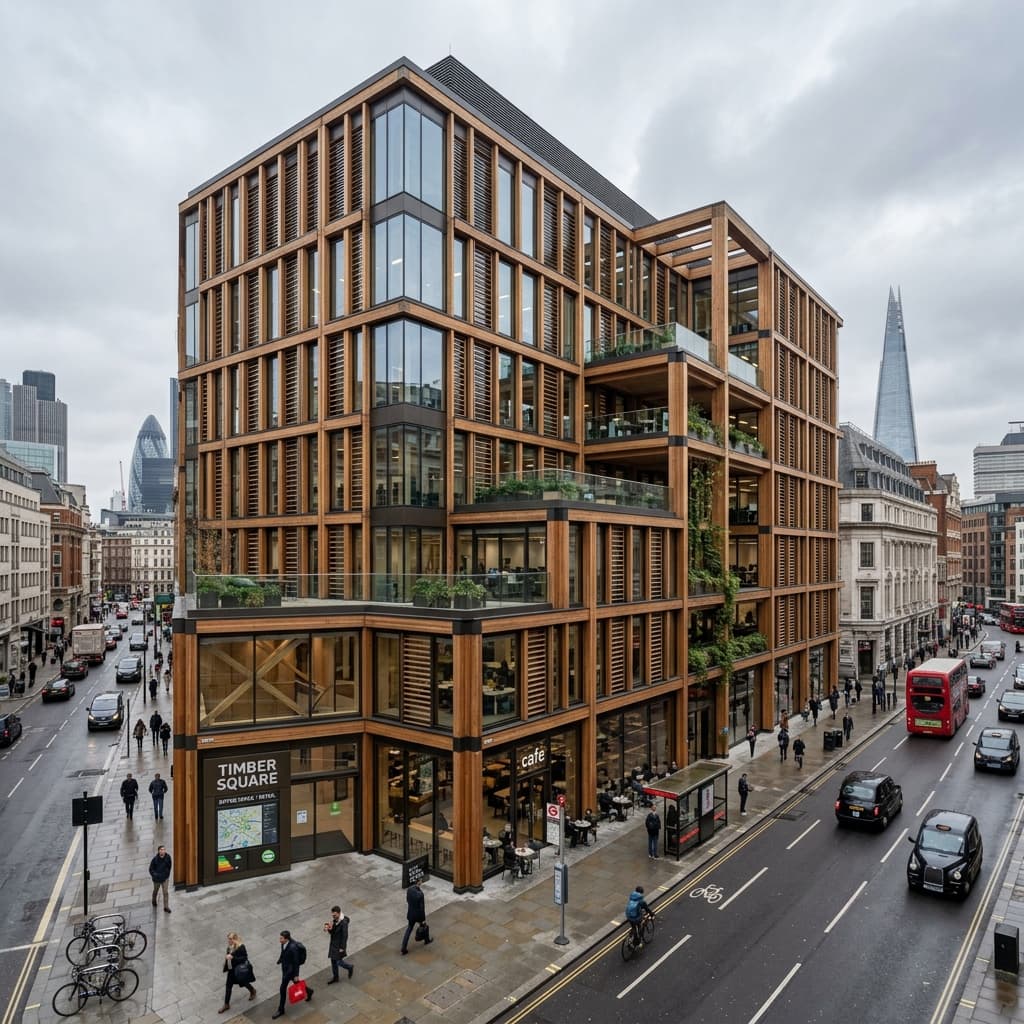
Visual
The image is tied to the article topic and stored in the portal's local media library.